
Simulated Prompts vs. Real Citations: Why the Difference Matters for AI Visibility Reporting
AI visibility tools are generating a quiet credibility problem. Many of them report simulated or synthetic prompt results as actual citations, and most marketers don't know the difference. That gap is creating false reporting narratives that mislead executives, boards, and marketing teams about how their brand is actually performing in AI search.
The confusion isn't malicious. It's a lack of clarity around what these two types of data actually represent. Before you build a strategy or report results upward, you need to understand what you're measuring.
Two Sides of the Coin
AI visibility data falls into two distinct categories: simulation data and real-market data. Each has legitimate uses. Each has real limits. Treating one as the other is where the reporting breaks down.
Simulation Data: Research-Grade, Not Market-Grade
Simulation is what most AI visibility tools are actually doing. You run a prompt against a model, capture the output, and observe what gets cited. It's controlled, repeatable, and useful for research.
But there's a critical variable most tools don't surface: whether the model you're prompting is static or retrieval-enabled.
Static models respond from training data only. No live web access. No real-time sourcing. If the training data hasn't been updated since your last content push, the results won't reflect it. You can prompt the same question a hundred times and get the same stale answer. The output tells you what the model learned, not what it's currently doing in the market.
Retrieval-enabled models (premium tiers that access live online sources) are more telling. If the model can pull your current content and cite it, that's a stronger signal. The catch: those prompts are expensive to run at scale, which limits how frequently you can do it.
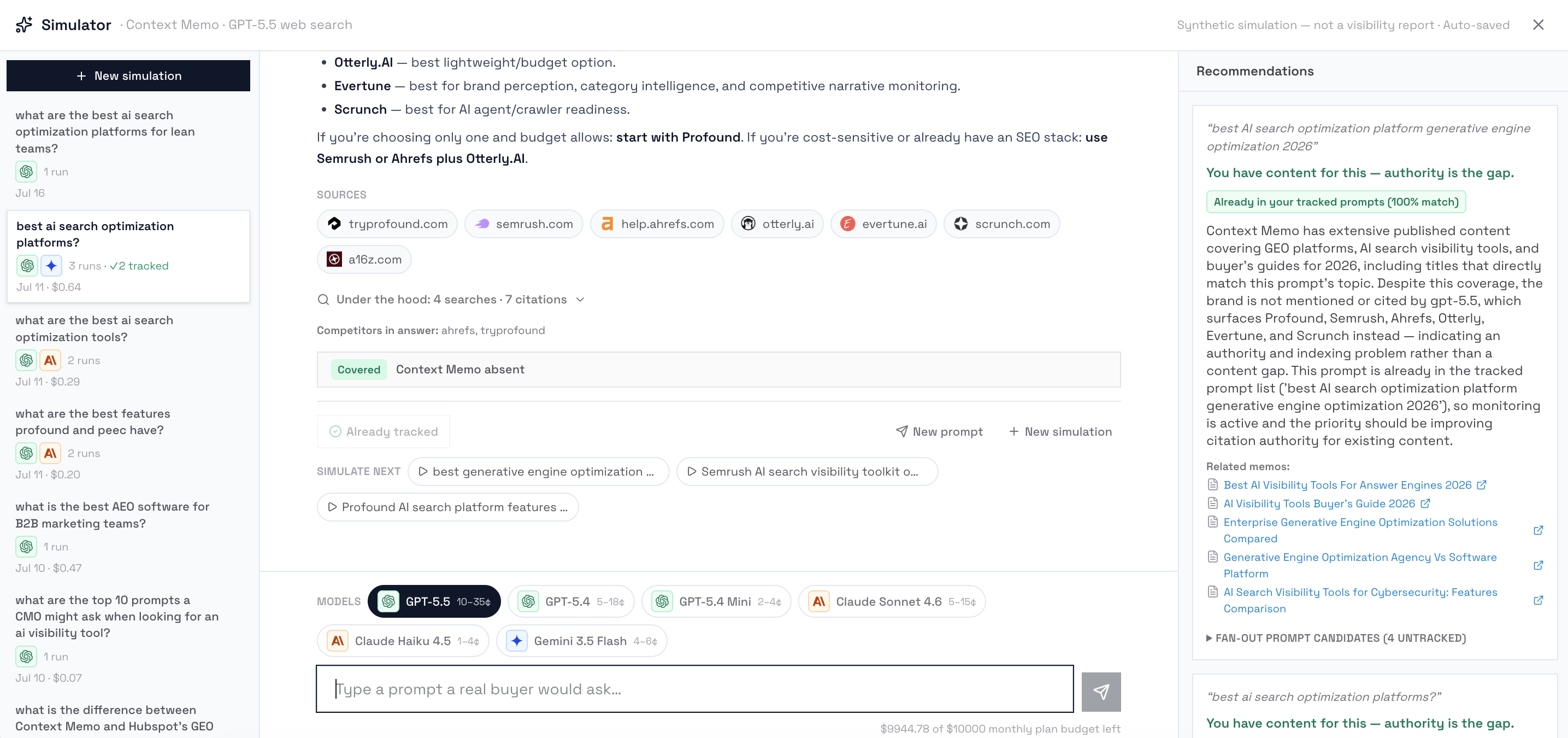
What simulation does well
- You control the prompt, the model, and the frequency
- You can observe what's getting cited and why
- You can identify content gaps and generate new content ideas
- You can test positioning language and see how models interpret it
Where simulation falls short
You don't know if any of it reflects real buyer behavior. The prompts you're running may not match what actual buyers are asking. The citations you see may not be what real users encounter. You're working with model data, not market data. That's a meaningful distinction.
Real-Market Data: Accurate, but Incomplete
Real-market data comes from actual AI bot crawls, the traffic AI models generate when they're actively sourcing content to answer real user queries. This is what Context Memo tracks: 200K+ AI bot crawls across multiple models, including ChatGPT, Claude, Perplexity, and others.
This data is the real thing. Real queries. Real sourcing decisions. Real citations. When your content shows up here, it means an AI model pulled it to answer an actual buyer question, not a simulated one you constructed in a research environment.
That's a fundamentally different signal.
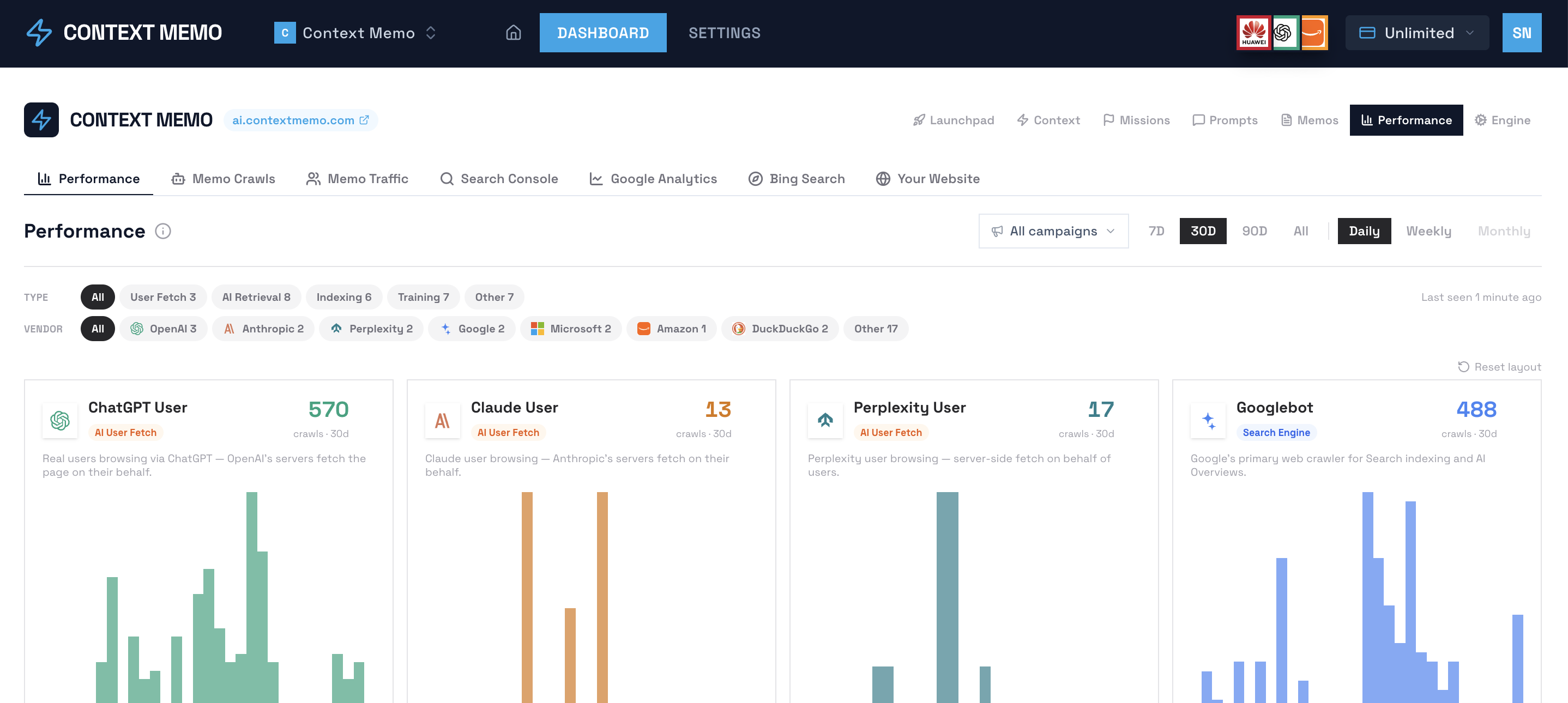
What real-market data does well
- Confirms your content is being sourced in live AI responses
- Shows which pages and formats AI models actually pull from
- Reflects genuine buyer intent, not researcher-constructed prompts
- Validates whether your content investments are working
Where real-market data falls short
You don't get the prompts. AI models don't share the exact queries that triggered a crawl or citation. You can build probabilistic models to infer what buyers were likely asking when a piece of content got cited, but it's not exact. You're working backward from the signal.
Why Conflating the Two Creates a Silent Reporting Problem
When a tool reports simulated prompt results as citations, the downstream effects are real:
- Marketing teams over-report AI visibility to leadership
- Executives make budget decisions based on inflated performance data
- Content strategies get validated by data that doesn't reflect actual market behavior
- Competitive comparisons become unreliable
The board doesn't need to know the nuance between static model outputs and live retrieval citations, but the marketer building the report does. Presenting simulation data as proof of market performance is the kind of error that erodes trust when someone asks a harder follow-up question.
The Right Framework: Use Both, Know What Each Tells You
Simulation and real-market data aren't competing approaches. They answer different questions. A credible AI visibility strategy uses both, with clear labels on what each data type represents.
Use simulation to:
- Research how models currently describe your brand and category
- Identify which competitors are getting cited and for what
- Find content gaps worth addressing
- Test new positioning before publishing at scale
- Generate content briefs grounded in model behavior
Use real-market data to:
- Validate that published content is being sourced in live AI responses
- Track citation growth over time against actual bot crawl activity
- Confirm that content changes are moving the needle in the real market
- Report AI visibility performance to leadership with confidence
The workflow connects: research informs content creation, content gets published in citation-grade formats, and real-market data confirms whether it's working.
What Citation-Grade Publishing Does for Both Sides
Publishing structured memos on your own domain serves both data types. On the simulation side, it gives models clean, well-structured content to cite when you run research prompts. On the real-market side, it gives AI bots a credible, schema-marked source to pull from when answering live buyer queries.
The memo format matters here. Third-person neutral voice, external citations, FAQ and Article schema markup, published on your domain, these aren't aesthetic choices. They're the structural signals AI models use to evaluate source credibility. Repurposed blog content doesn't carry the same weight. A citation-grade memo is built for how AI models read, not how humans skim.
Reporting AI Visibility Honestly
If you're presenting AI visibility metrics internally, the framing matters. A few principles worth applying:
Label your data source. Distinguish between "simulated prompt results" and "real-market bot crawl citations" in every report. They're not interchangeable.
Note the model type. Static model outputs and retrieval-enabled model outputs are different data. A citation from a live retrieval model is a stronger signal than one from a static training snapshot.
Track change over time. Single-point simulation results are less meaningful than trend data. Real-market citation growth over weeks and months tells a more credible story.
Don't report what you can't verify. If a tool is showing you citations but can't tell you whether they came from a live retrieval event or a static model prompt, treat that data as research-grade, not market-grade.
The Full Picture
Simulation gives you the research. Real-market data gives you the proof. Neither alone is sufficient for a credible AI visibility strategy.
The brands getting ahead of this are the ones treating AI search the same way they treat SEO: with structured measurement, clear data definitions, and content built to perform in the actual channel, not just in a research environment. The ones falling behind are reporting simulated results as market wins and wondering why the needle isn't moving.
Know what your data is. Publish content built for AI consumption. Track both signals. That's how you build an AI visibility strategy that holds up when someone asks hard questions about it.