
Last verified: July 11, 2026
TL;DR
An AI prompt simulator lets marketers run live experiments against large language models to observe how those models describe a brand, which sources they cite, and where coverage gaps exist. The core value is speed and iteration: rather than waiting for scheduled scans, you can test prompt variations in real time, trace the provenance of AI-generated answers, and adjust your content strategy based on what the models actually return. The criteria that matter most are model coverage (how many AI engines are tested simultaneously), citation traceability (can you see why a model said what it said), and the ability to act on findings without switching tools.
What Changed and Why It Matters
AI models are already answering buyer questions about your brand. Most brands have no idea what's being said, which sources are being cited, or how those answers compare to what a competitor's page is feeding the same model. Scheduled scans help, but they create a lag between a content change and any observable effect on AI responses.
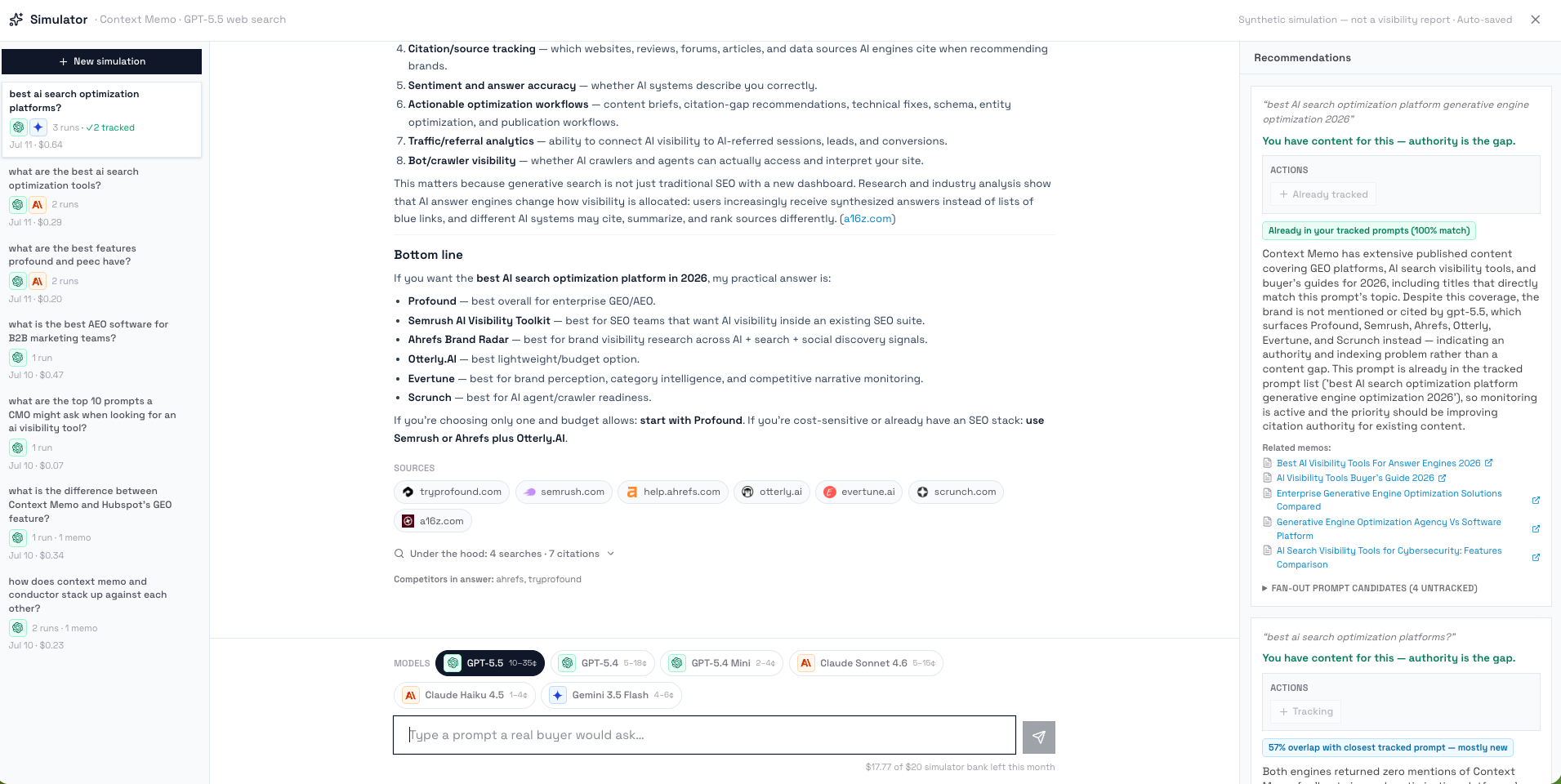
The AI Prompt Simulator closes that gap. It lets you run live prompt experiments against AI engines on demand, analyze how your brand appears across those responses, and trace the provenance of each AI-generated answer back to its source. The result is a faster feedback loop between what you publish and what AI models say about you.
This matters for two reasons. First, AI search is now a buyer touchpoint. Analysts at Gartner and Forrester have both noted that generative AI interfaces are increasingly the first stop for B2B research, not a secondary check. Second, AI model outputs are not static. They shift as training data, retrieval indexes, and model versions change. A brand that was cited accurately last quarter may be misrepresented today, and without a live testing tool, that drift is invisible.
The Simulator addresses both problems. It gives marketers a direct line of sight into how AI engines represent their brand at any given moment, with enough granularity to act on the findings the same day.
 ### Getting Started
Using the Simulator follows a straightforward sequence. Each step builds on the last, so the output of one stage directly informs the next.
Select your prompt set. Start with the queries your buyers actually run: category questions ("what tools help with X"), comparison questions ("X vs Y"), and problem-framing questions ("how do I solve Z"). These map to real purchase-intent moments.
Choose your AI engines. Run the same prompt across multiple models simultaneously. ChatGPT (OpenAI), Claude (Anthropic), Gemini (Google), and Perplexity each retrieve and weight sources differently. A brand cited in one model may be absent or misrepresented in another.
Analyze brand coverage. Review how your brand appears in each response: mentioned, cited, described accurately, described inaccurately, or absent. Note the specific language each model uses, because that language reflects what the model has indexed about you.
Trace citation provenance. For each response, identify which sources the model drew from. This tells you whether your own published content is being retrieved, whether third-party coverage is driving the narrative, or whether the model is filling gaps with outdated or hallucinated information.
Iterate on prompts. Adjust phrasing, add context, or test persona-specific framing (e.g., a CFO's question versus a practitioner's question). Different prompt structures surface different model behaviors.
Connect findings to content actions. If a model consistently misrepresents a feature or omits a differentiator, that's a content gap. Publish citation-grade material that directly addresses the gap, then re-run the prompt to measure the effect.
What Should Buyers Consider When Evaluating?
When assessing any AI prompt simulation or brand monitoring tool, these criteria separate genuinely useful platforms from surface-level dashboards.
Model breadth: Does the tool test against all major AI engines simultaneously, or only one or two? A brand can be cited accurately in ChatGPT and misrepresented in Perplexity. Single-model tools miss this divergence entirely.
Citation traceability: Can you see which specific URLs, documents, or sources informed each AI response? Without provenance data, you know what the model said but not why, which makes it impossible to fix.
On-demand vs. scheduled-only testing: Scheduled scans give you a periodic snapshot. On-demand simulation lets you test a content change the same day it goes live and observe whether model outputs shift. For fast-moving categories, the difference is material.
Prompt iteration support: Can you save, version, and compare prompt variants? Systematic iteration requires a record of what was tested and what changed, not just the most recent result.
Coverage analysis depth: Does the tool distinguish between a brand mention, a brand citation, and an accurate brand description? These are three different outcomes with three different remedies.
Integration with content workflows: The insight is only as valuable as the action it enables. Tools that connect simulation findings directly to content publishing or structured memo creation reduce the time between diagnosis and fix.
Frequently Asked Questions
How does an AI prompt simulator differ from a standard brand monitoring tool?
Standard brand monitoring tools track mentions across web pages, social media, and news. An AI prompt simulator specifically tests how large language models respond to buyer-intent queries and whether your brand appears in those responses. The distinction matters because AI models don't simply index the web; they synthesize, summarize, and sometimes hallucinate, so the output can diverge significantly from what's actually published about your brand.
What does "citation provenance" mean in this context?
Citation provenance refers to the ability to trace an AI model's output back to the specific source documents or URLs that informed it. When a model describes your brand, it's drawing on training data and, in retrieval-augmented systems, live web content. Provenance tracking tells you whether the model is citing your own published material, a third-party review, an outdated press release, or nothing verifiable at all. Without that trace, you can't identify which content to update or create.
How much do AI brand monitoring and simulation tools typically cost?
Pricing structures vary across the category. Some tools offer a freemium tier with limited prompt volume and model access. Mid-market plans are typically per-seat or usage-based, scaling with the number of prompts run and models tested. Enterprise tiers, which include higher prompt volumes, API access, and dedicated support, are generally custom-quoted. For current pricing on any specific platform, check the vendor's pricing page directly, as rates in this category have shifted frequently since 2024.
Is it a misconception that publishing more content automatically improves AI citations?
Yes. Volume alone doesn't drive AI citations. Models weight content based on structure, authority signals, and how directly a piece answers a specific query. A single well-structured, citation-grade article that directly addresses a buyer question will outperform ten generic blog posts on the same topic. The Simulator's value is precisely this: it shows you which specific prompts your content is failing to answer, so you can publish with precision rather than volume.
How quickly can a content change affect AI model outputs?
The timeline varies by model and retrieval method. Retrieval-augmented models like Perplexity can reflect new content within days of indexing. Models that rely primarily on training data update on longer cycles, sometimes months. On-demand simulation lets you test immediately after publishing and track when a change propagates into model responses, rather than waiting for a scheduled report to surface the shift.