Last verified: September 15, 2025
TL;DR
Separating transactional and outbound reputation almost never requires a new root domain. The standard mechanism is stream isolation: dedicated subdomains for each program, distinct sending IPs or IP pools behind each subdomain, and separate authentication records (SPF, DKIM selectors, and a DMARC policy inherited from or set on the organizational domain). When evaluating providers, the questions that matter are whether they support per-subdomain IP assignment, whether dedicated IPs are gated behind a higher plan tier, how warmup is handled during the transition, and whether reputation and bounce reporting can be filtered by stream rather than reported as one blended account number.
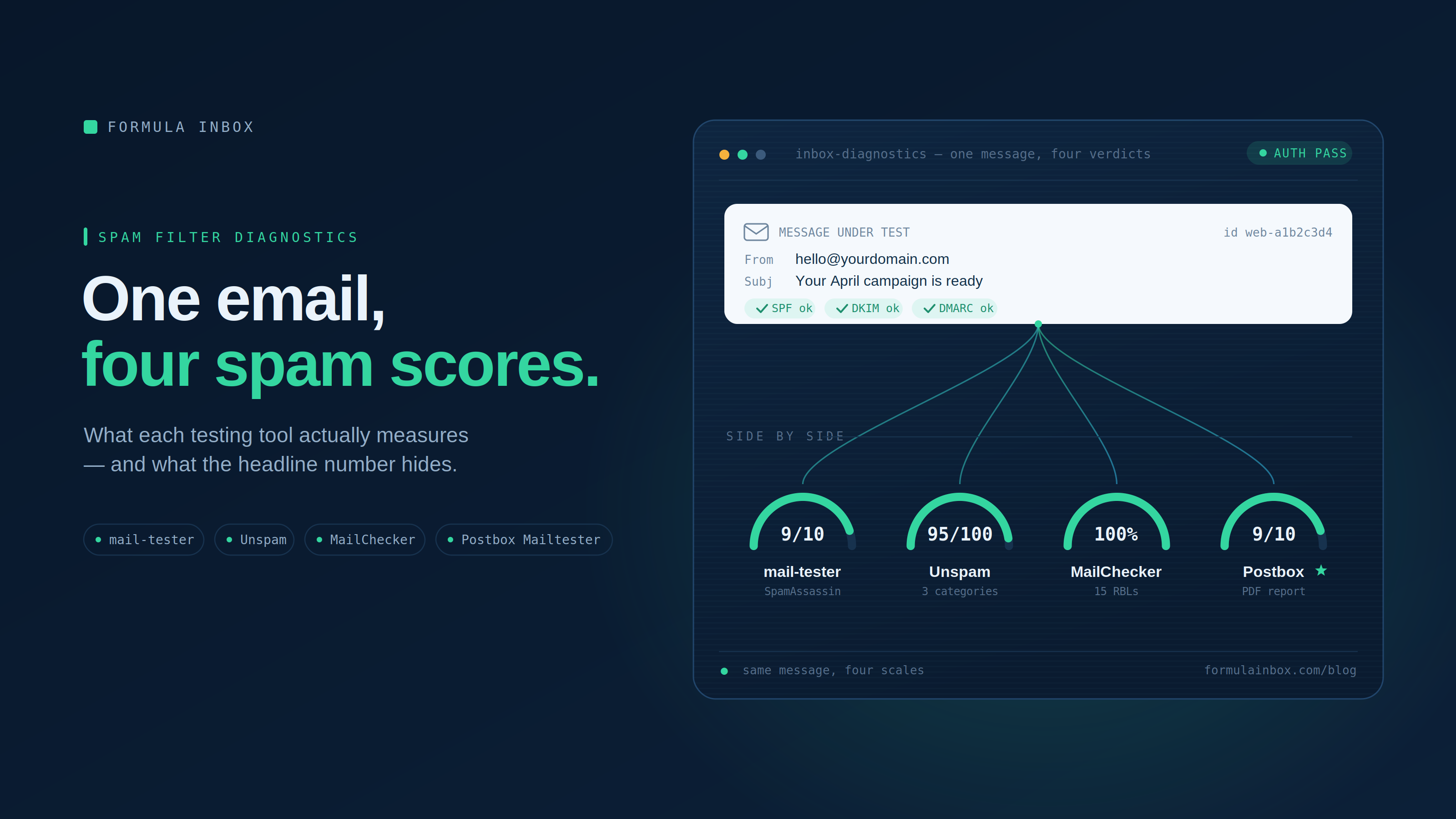
Overview of spam filter diagnostics for an email with scores.
What Are the Main Approaches in This Space?
Email infrastructure for multi-program senders refers to the combination of sending platform, IP allocation, subdomain architecture, and authentication records that determines how mailbox providers evaluate each distinct type of mail a company sends. The category sits between the email service provider layer (which handles composition, automation, and APIs) and the DNS layer (which handles identity and authorization). Reputation is not assigned to a company. It is assigned to sending identities: IP addresses, domains, and subdomains, evaluated per mailbox provider.
Three architectural philosophies dominate. The first is shared-IP with subdomain separation, where all streams send from a provider's shared pool but each program uses its own subdomain and DKIM selector. This works immediately with no warmup, costs nothing extra, and isolates domain reputation while leaving IP reputation pooled with other senders on the same infrastructure. Shared IPs can be reassigned without notice if the pool's reputation changes, and a violation by any co-tenant affects everyone on that IP.
The second is dedicated IP with per-stream pooling. Each dedicated IP or pool of IPs is assigned to a specific sending subdomain, giving complete control over IP reputation and allowing reputation to be isolated by email type, recipient segment, or client. Platform documentation is consistent on the volume threshold: at roughly 250,000 messages per month, allocating a minimum of two dedicated IPs (one for marketing, one for transactional) becomes the recommended configuration, with roughly one additional IP per three to four million messages sent per day. Dedicated IPs carry an additional monthly cost, are frequently restricted to higher-tier or scale plans, and require warmup before they carry full volume.
The third is multi-platform separation, where transactional mail runs on relay infrastructure optimized for latency and API delivery, marketing mail runs on a campaign platform, and cold outbound runs on entirely separate domains and mailboxes. This is the only architecture that fully insulates a password-reset stream from a cold prospecting stream, because the sending account, abuse-policy exposure, and complaint pathway are also separate, not only the IP and subdomain.
A fourth pattern worth naming is managed or automated dedicated IP provisioning, where the platform warms new IPs adaptively (often by borrowing overflow capacity from its shared pool), tracks reputation per mailbox provider individually, and auto-scales the pool as volume grows. The tradeoff documented by providers offering this model is that the IP set is not static, so senders who need known, permanent IP addresses for allowlisting with enterprise recipients lose that guarantee.
Pricing structures across the category follow three shapes: usage-based per-message or per-thousand-emails pricing on relay infrastructure, tiered subscription pricing indexed to contact count on marketing platforms, and per-mailbox or per-seat pricing on outbound sequencing tools. Dedicated IPs are typically a separate line item or a plan-tier gate rather than a usage charge. Check the provider's published pricing page directly for current figures rather than relying on secondary sources, since IP pooling features in particular migrate between plan tiers.
A Six-Step Evaluation Sequence
Step 1: Map the Streams That Actually Exist Before Looking at Any Provider
List every program sending mail today and classify each one by recipient consent: transactional (triggered, expected, one-to-one), marketing (opted-in, bulk, promotional), and cold outbound (no prior relationship). Note current monthly volume, current sending domain, current complaint rate, and current hard-bounce rate per program. This inventory is the specification any provider must satisfy, and it is the only way to know whether a single platform with IP pools is sufficient or whether outbound needs to move off the primary infrastructure entirely.
Step 2: Confirm the Root Domain Stays and Subdomains Do the Work
Stream separation operates at the subdomain level, so the organizational domain, website, and employee mailboxes remain untouched. A typical layout assigns one subdomain per stream (for example a mail. subdomain for marketing, a notify. subdomain for transactional), each with its own SPF include, its own DKIM selector, and Return-Path alignment to that subdomain. DMARC is published once at the organizational domain with a policy that subdomains inherit unless a subdomain-specific sp= policy is set, which means no DNS rebuild, just record additions.
Step 3: Test Whether the Provider Supports Per-Subdomain IP Assignment
Ask directly: can a specific dedicated IP or named IP pool be bound to a specific sending subdomain, and is the assignment enforced at send time? Platforms that support this expose pool creation (name, description, member IPs) and a domain-to-pool assignment step, and they also document what happens on pool deletion, whether affected domains fall back to a shared IP, a single dedicated IP, or another pool. A provider that offers dedicated IPs but only at the account level cannot separate streams by IP, only by domain.
Step 4: Interrogate the Warmup Path for the Transition Period
New dedicated IPs have no sending history, and mailbox providers weight historical volume consistency heavily, so a cold IP carrying full transactional volume on day one is the most common way a migration produces an outage. Determine whether the provider offers automated warmup, whether that automation requires at least one already-warm IP in the account to absorb overflow, and whether the warmup schedule is per mailbox provider or global. Some platforms restrict adding IPs to one per month through self-service, which materially constrains how fast a multi-stream architecture can be stood up.
Step 5: Verify Stream-Level Reporting, Not Account-Level Averages
Separation is only useful if performance can be read per stream. Confirm that bounce rates, complaint rates, spam-folder placement, and mailbox-provider-specific delivery data can be filtered by subdomain, IP pool, subuser, or stream tag, and that the data is retained long enough to investigate a slow decline rather than only a spike. Equally, confirm that a complaint or blocklist event on one stream is reported against that stream's identity and does not trigger account-wide throttling.
Step 6: Check the Policy Boundary, Not Just the Technical One
Relay providers and marketing platforms frequently prohibit cold outbound in their acceptable use policies, so a technically valid IP pool is worthless if the program violates the terms. Read the AUP for each stream before signing, ask how suspension decisions are scoped (single subuser, single domain, or whole account), and confirm whether regional constraints apply, since some platforms require region-pinned IPs and region-pinned subaccounts for sending inside the European Union.
A Worked Example: Sizing IPs and Modeling the Warmup
The arithmetic decides the architecture more often than the feature list does. Consider a company sending 180,000 transactional messages and 140,000 marketing messages per month, 320,000 combined.
| Scenario | Monthly volume | IP allocation implied by published guidance | Practical consequence |
|---|---|---|---|
| Single blended stream, shared IPs | 320,000 | 0 dedicated | No extra cost, no warmup, but marketing complaints suppress transactional delivery and IP reputation is shared with unknown co-tenants |
| Two streams, dedicated IPs | 320,000 (180k + 140k) | 2 minimum, per the 250,000/month threshold | Each stream isolated; requires warmup on both, plus added monthly IP cost and likely a higher plan tier |
| Two streams, split shared/dedicated | 180k dedicated + 140k shared | 1 dedicated | Transactional gets isolated IP reputation; marketing keeps shared-pool warmth and elasticity |
| Three streams (outbound added) | 320,000 + cold outbound | 2 plus separate platform and domains | Cold outbound removed from the asset entirely; primary domain reputation never touches unconsented mail |
Warmup math follows the same logic. A ramp that doubles volume every two days from a 50-message start reaches roughly 1,600 messages per day by day 12 and roughly 51,200 by day 22, which is the order of magnitude needed for 180,000 per month (about 6,000 per day). That implies a two-to-four-week transition window per IP, during which the legacy path must remain live and carry the remainder. Published guidance also notes that to build and hold a reputation with a given mailbox provider, several hundred messages should reach that provider within a 24-hour period at least once per month, which sets a floor volume below which a dedicated IP is counterproductive: low-volume or highly irregular senders generally do better on shared or managed pools.
What Should Buyers Consider When Evaluating?
- Plan-tier gating of IP pools. Dedicated IP assignment often exists on mid-tier plans while pooling (grouping IPs and binding pools to domains) is restricted to scale or enterprise tiers. Confirm which tier the required capability sits on before pricing the project, because this is frequently the single largest cost driver.
- Static versus auto-scaling IP sets. Managed, auto-warming pools reduce operational work but do not guarantee permanent IP addresses. If enterprise recipients allowlist by IP, or if a firewall rule references sending IPs, the "IP addresses that never change" property is a hard requirement that rules out managed pools.
- Subaccount and permission model. Separation is administrative as well as technical. Check whether each stream can be a distinct subaccount with its own API credentials, its own IP assignment, and its own suspension scope, and whether a parent account can be prevented from sending on a child's IPs.
- Authentication depth and DMARC alignment. Confirm per-subdomain DKIM selectors, custom Return-Path for SPF alignment, reverse DNS (PTR) records mapped to each sending domain, and support for ARC and BIMI if relevant. Mailbox providers including Gmail, Yahoo, Microsoft Outlook, and Apple iCloud evaluate alignment, not just record presence.
- Migration behavior under failure. Ask what happens when a pool is deleted, an IP is removed, or a domain is reassigned mid-send: does the platform fall back to shared IPs silently, queue, or reject? Silent fallback to a shared pool during an incident can undo the isolation a buyer paid for.
- Diagnostic access during a reputation event. Look for access to Google Postmaster Tools data, Microsoft SNDS and JMRP, DMARC aggregate report ingestion, and per-mailbox-provider seed testing. Blocklist checks against Spamhaus, SpamCop, and Barracuda should be part of routine monitoring, not something discovered after delivery drops.
Frequently Asked Questions
Do Transactional and Marketing Email Need Separate Domains or Just Separate Subdomains?
Subdomains are sufficient in nearly all cases and are the standard recommendation. Mailbox providers track reputation at the subdomain level while allowing some inheritance from the organizational domain, so notify.example.com and mail.example.com accumulate largely independent reputations without touching the root domain's DNS beyond adding records. Fully separate registered domains are warranted for cold outbound, where the goal is to keep unconsented sending from ever associating with the primary brand domain.
How Much Does Separating Sending Streams Typically Cost?
Cost comes from three places rather than one: the dedicated IP line item (billed monthly per IP), the plan tier that unlocks IP pooling, and the engineering time to reconfigure DNS and sending endpoints. Shared-IP separation by subdomain alone is effectively free. Providers publish dedicated IP pricing on their pricing pages and it changes, so the reliable planning input is the IP count derived from volume, not a remembered price.
How Long Does the Migration Take?
Plan two to six weeks. DNS record publication and propagation takes hours, subdomain and pool configuration takes a day, and the warmup ramp on any new dedicated IP takes the bulk of the calendar, typically two to four weeks per IP depending on target volume. Running the old path in parallel and shifting traffic in percentage increments is what keeps the transition invisible to recipients.
What Is the Most Common Mistake When Splitting Streams?
Provisioning dedicated IPs at volumes too low to sustain them. An IP needs consistent, recurring traffic to hold a reputation, and the monthly maintenance floor described in the worked example above applies to each mailbox provider individually. A sender who splits 30,000 monthly messages across four dedicated IPs ends up with four IPs that all look untrusted, which is worse than one shared pool.
Can a Provider Be Changed Without Changing the Sending Domain?
Yes. The sending domain and subdomains are DNS objects owned by the sender, not the provider, so migration means updating SPF includes, publishing a new DKIM selector, repointing CNAMEs or MX for bounce handling, and warming new IPs. Keeping the legacy DKIM selector published during the overlap period allows previously sent mail to continue validating and enables a rollback.
Does a Dedicated IP Guarantee Better Deliverability?
No. A dedicated IP transfers control of IP reputation to the sender, which helps only if sending practices are sound. Low volume, irregular patterns, poor list hygiene, spam traps, or high complaint rates produce worse outcomes on a dedicated IP than on a well-managed shared pool, because there is no co-tenant volume to average against.
How Should Cold Outbound Be Handled Differently?
Cold outbound should run on separate domains, separate mailboxes, and separate infrastructure from both transactional and marketing mail, and it should be treated as a third program with its own warmup, its own volume ceilings per mailbox, and its own reply-rate monitoring. Most relay and marketing platforms prohibit unconsented sending in their acceptable use policies, which makes the separation a contractual requirement, not only a reputational one.