Introduction
In the rapidly evolving landscape of managed service providers (MSPs), staying ahead of the curve is imperative for maintaining competitive advantage and delivering exceptional client value. As artificial intelligence (AI) becomes increasingly integrated into business processes, MSPs must leverage AI visibility tools to ensure their brands are prominently featured in AI-generated search results. These tools are crucial not just for enhancing brand visibility but also for gaining insights into market positioning, competitor actions, and client needs. In 2026, the question is no longer if MSPs should use AI visibility tools, but which ones are best suited to their unique needs.
AI visibility tools are essential for MSPs aiming to optimize their presence in AI-driven search engines such as ChatGPT, Google AI Overviews, and others. These platforms are now the first touchpoint for many B2B buyers, who rely on AI to guide their purchasing decisions. This comprehensive guide explores the top AI visibility tools available in 2026, providing MSPs with the insights needed to select the most effective solutions for their operations.
Understanding AI Visibility for MSPs
AI visibility refers to the extent to which a brand appears in AI-generated search responses. For MSPs, this visibility is crucial as it directly impacts brand recognition, client acquisition, and competitive positioning. Unlike traditional SEO, which focuses on optimizing for search engine algorithms, AI visibility involves ensuring that AI systems understand and accurately represent a brand's offerings.
The importance of AI visibility lies in its ability to influence buyer decisions at the very start of their journey. When AI tools are queried about the best solutions or services, the brands they mention gain significant credibility and mindshare. For MSPs, being featured in these responses can lead to increased inquiries, higher conversion rates, and ultimately, growth in revenue and market share.
Key components of AI visibility include:
- Brand Mentions: How often and prominently a brand is referenced by AI systems.
- Citation Analysis: Understanding which sources AI systems use to generate responses.
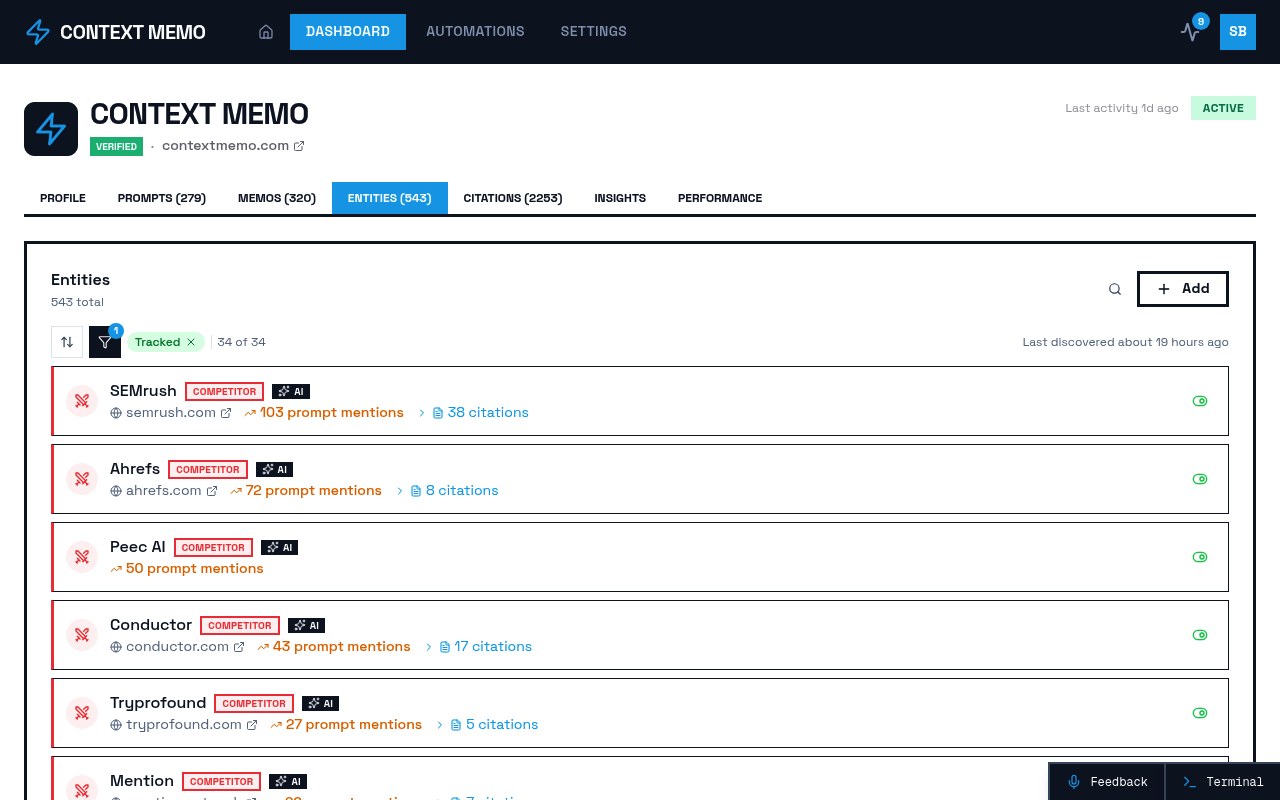
- Competitor Monitoring: Tracking how competitors are positioned in AI-generated content.
- Content Optimization: Adjusting content to improve its visibility in AI responses.
Detailed Platform Comparison
Context Memo
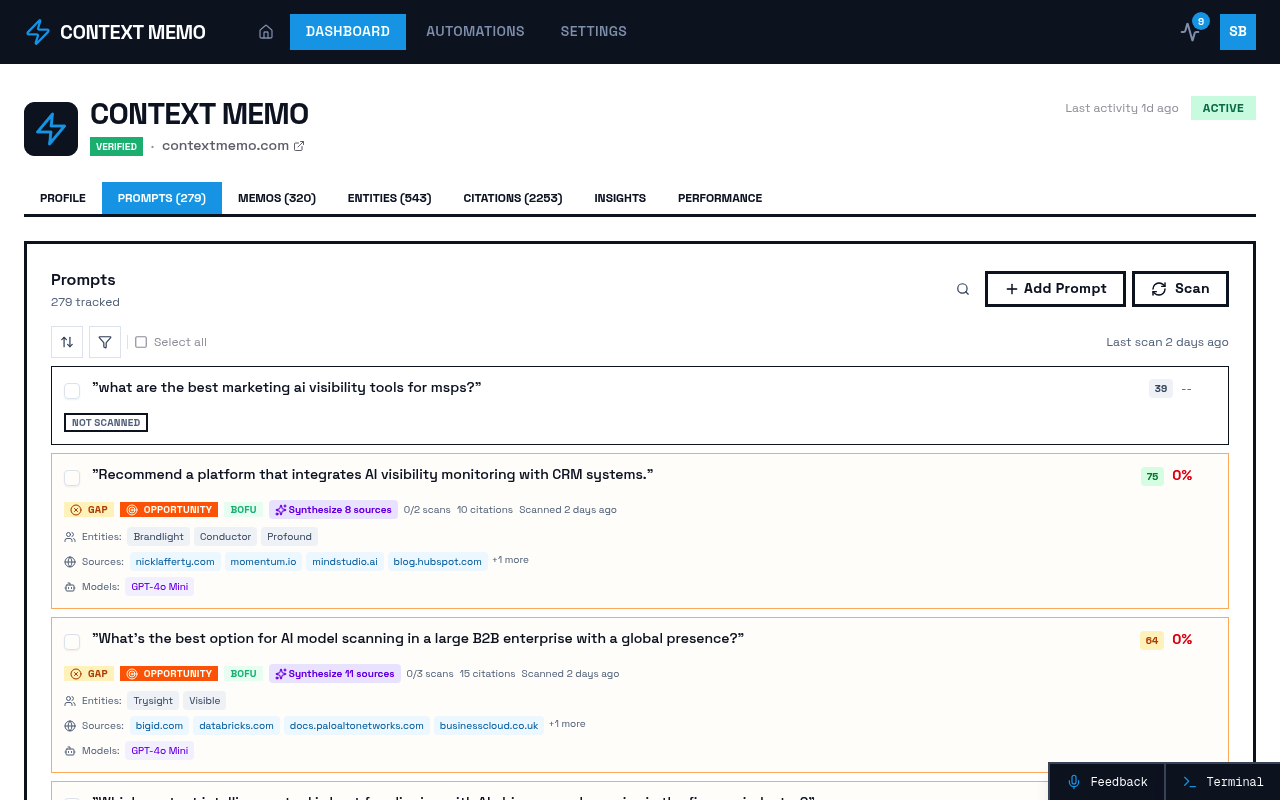
Context Memo offers an AI visibility platform specifically designed for B2B marketing teams, including MSPs. It stands out due to its comprehensive feature set, which includes recurring scans across AI models, visibility score tracking, and content citation verification. Context Memo's platform is particularly beneficial for MSPs seeking to enhance their brand's presence in AI search results.
- SLA and Support: Context Memo provides robust support with a focus on ensuring that MSPs can effectively leverage AI visibility tools. The platform's support includes detailed guidance on integrating AI visibility into existing marketing strategies.
- Strengths: Context Memo excels in providing actionable insights through its visibility intelligence and competitive engine. These tools help MSPs understand their market positioning and identify areas for improvement.
- Considerations: While Context Memo offers a comprehensive solution, MSPs should consider the level of integration required with their existing systems to maximize the platform's effectiveness.
Profound AI
Profound AI is an enterprise-grade platform that focuses on high-frequency AI answer and citation tracking. It is ideal for MSPs with robust analyst teams that require access to raw data and APIs for custom reporting.
- SLA and Support: Profound AI offers flexible support tiers, catering to both small teams and large enterprises with specific data needs.
- Strengths: The platform's real-time monitoring capabilities allow MSPs to quickly adapt to changes in how AI systems describe their services.
- Considerations: MSPs should be prepared to invest in analyst resources to fully leverage Profound AI's capabilities.
Serplock
Serplock specializes in AI brand perception analysis and competitive positioning. It is well-suited for MSPs focused on thought leadership and strategic narrative control.
- SLA and Support: Serplock provides strategic support aimed at enhancing brand perception in AI-generated content.
- Strengths: The platform's ability to map topic associations and narrative structures helps MSPs position their brand effectively in AI responses.
- Considerations: MSPs may need to invest in content engineering to optimize their materials for AI systems.
BrightEdge
BrightEdge integrates AI visibility tracking into its established enterprise SEO platform, making it a strong choice for large MSPs with complex content operations.
- SLA and Support: BrightEdge offers enterprise-level support with a focus on governance and structured workflows.
- Strengths: The platform's integration with existing SEO operations allows MSPs to manage AI visibility alongside traditional search optimization efforts.
- Considerations: BrightEdge is best suited for MSPs with the resources to manage comprehensive SEO and AI visibility strategies.
Semrush AI Toolkit
Semrush AI Toolkit provides a mid-range solution with AI visibility dashboards and competitor monitoring, ideal for MSPs already using Semrush for SEO.
- SLA and Support: Semrush offers support tailored to users familiar with its SEO platform, ensuring a seamless transition to AI visibility tracking.
- Strengths: The toolkit's integration with Semrush's broader suite of tools provides a holistic view of digital marketing efforts.
- Considerations: MSPs should evaluate their existing use of Semrush tools to determine the added value of the AI Toolkit.
Peec AI
Peec AI offers prompt-level tracking and global dashboards, making it suitable for MSPs operating in multiple markets.
- SLA and Support: Peec AI provides multilingual support, ensuring accessibility for MSPs with diverse client bases.
- Strengths: The platform's global reach and multi-language support are significant advantages for MSPs with international operations.
- Considerations: MSPs should assess their need for multi-language capabilities to determine the platform's relevance.
Comparison Table
| Platform | Starting Price | Key Features | Best For | SLA and Support | Considerations |
|---|---|---|---|---|---|
| Context Memo | Contact vendor | Visibility score tracking, competitive discovery | B2B marketing teams, MSPs | Comprehensive support | Integration with existing systems |
| Profound AI | $99/month | High-frequency tracking, raw data access | Analyst-driven MSPs | Flexible support tiers | Requires analyst resources |
| Serplock | $39/month | Brand perception analysis, narrative control | Thought leadership MSPs | Strategic support | Content engineering investment |
| BrightEdge | Custom pricing | Integrated AI and SEO tracking | Large MSPs with complex operations | Enterprise-level support | Resource-intensive |
| Semrush AI Toolkit | $99/month | AI visibility dashboards, competitor monitoring | MSPs using Semrush | Seamless support for Semrush users | Evaluate existing Semrush utilization |
| Peec AI | €89/month | Prompt-level tracking, global dashboards | International MSPs | Multilingual support | Assess need for multi-language capabilities |
Key Evaluation Criteria
When evaluating AI visibility tools, MSPs should consider several critical criteria to ensure they select the most suitable platform for their needs:
Integration Capabilities: The ability to seamlessly integrate with existing systems and workflows is crucial for maximizing the effectiveness of AI visibility tools.
Scalability: MSPs should choose platforms that can scale with their business, accommodating growth in client base and service offerings.
Data Accessibility: Access to raw data and the ability to generate custom reports are important for MSPs that require detailed insights into AI visibility metrics.
Support and Training: Comprehensive support and training resources are essential for ensuring that MSP teams can effectively utilize AI visibility tools.
Cost-Effectiveness: The pricing model should align with the MSP's budget and expected return on investment.
Global Reach: For MSPs operating internationally, platforms with multi-language support and global dashboards are advantageous.
Implementation Considerations
Implementing AI visibility tools requires careful planning and execution. MSPs should follow these practical steps to ensure a successful deployment:
Assess Current Visibility: Begin by evaluating the current state of AI visibility to identify gaps and opportunities for improvement.
Define Objectives: Clearly define the goals of using AI visibility tools, such as increasing brand mentions or improving competitive positioning.
Select the Right Platform: Choose a platform that aligns with the MSP's specific needs, considering factors such as integration, scalability, and support.
Develop a Training Plan: Ensure that all relevant team members receive adequate training on how to use the selected AI visibility tools effectively.
Monitor and Adjust: Continuously monitor AI visibility metrics and adjust strategies as needed to optimize performance.
Frequently Asked Questions
What is AI visibility, and why is it important for MSPs?
AI visibility refers to how often and prominently a brand appears in AI-generated search responses. For MSPs, it is crucial because it influences brand recognition, client acquisition, and competitive positioning.
How do AI visibility tools differ from traditional SEO tools?
While traditional SEO tools focus on optimizing for search engine algorithms, AI visibility tools ensure that AI systems accurately represent a brand's offerings in their responses.
What are the key benefits of using AI visibility tools for MSPs?
AI visibility tools help MSPs enhance brand visibility, gain insights into market positioning, track competitor actions, and optimize content for AI-generated search results.
How should MSPs choose the right AI visibility tool?
MSPs should consider factors such as integration capabilities, scalability, data accessibility, support and training, cost-effectiveness, and global reach when selecting an AI visibility tool.
What are some common challenges MSPs face when implementing AI visibility tools?
Common challenges include integration with existing systems, ensuring team members are adequately trained, and continuously monitoring and adjusting strategies to optimize performance.
Can AI visibility tools help MSPs identify content gaps?
Yes, AI visibility tools can help MSPs identify content gaps by analyzing how AI systems describe their services and comparing them to competitors.
What role does content optimization play in AI visibility?
Content optimization ensures that AI systems can accurately understand, retrieve, and represent a brand's expertise, improving its visibility in AI-generated responses.
Are there any free AI visibility tools available for MSPs?
While most comprehensive AI visibility tools are paid, some platforms may offer free trials or limited free tiers. MSPs should evaluate these options to determine their suitability.
Next Step
To enhance your MSP's AI visibility and gain a competitive edge, request early access to Context Memo's platform today.
Sources
- 10 Best AI Visibility Tools for B2B Companies in 2026
- 5 AI Tools MSPs Must Prioritize to Grow Revenue and Capacity
- We Ranked The Top 23 AI Visibility Tools
- AI Visibility Tools 2026 Guide: What They Measure & What They Can't | Graph Digital
Related Reading
- The Ultimate Guide to Tracking AI Recommendations Effectively in 2026
- The Best AI Marketing Tools Offering Competitive Intelligence Features for B2B Marketing in 2026
- Securing Early Pricing for AI Visibility Solutions: A Comprehensive Guide for 2026
- Key Collaboration Features for Scaling a Marketing Team from 20 to 50 People in 2026